
Read Itasca County Release Dates
A projected or scheduled release date is an operational calculation based on the sentence and information known at that time. It is not a promise. The actual release date records when the custodian completed the event. A final discharge date means the relevant sentence and correctional authority ended. Those three dates can be different.
Custody type changes the answer. Someone awaiting trial at Itasca County Jail may leave after bond is posted, a court order is entered, charges are resolved, or another hold clears. There may be no fixed public date in advance. A person serving a local sentence has a county calculation based on the court commitment, jail credit, local custody rules, and other holds. A person committed to Minnesota DOC uses the state sentence framework and DOC records.
- Projected date
- A current estimate that can change as the sentence and credits are administered.
- Supervised release
- The community portion of a Minnesota prison sentence under DOC authority.
- Final discharge
- The end of DOC jurisdiction for the sentence, not merely departure from prison.
- Detainer
- A notice that another authority may seek custody, which can block community release.
Find an Itasca County Release Date
Start with the facility that holds or last held the person. The Itasca County Jail roster is a current-custody tool. Its public cards do not show a verified projected release date or post-release archive. If a person remains listed, use the charge details and court case to understand the pending authority. If the card is gone, absence alone cannot tell whether the event was release, transfer, or a correction.
For a person committed to Minnesota DOC, use the DOC public viewer. Search by first and last name or the complete six-digit MNDOC Offender ID. Name searches include prior names and conviction-related aliases and use prefix behavior. A newly sentenced person may take several business days to enter the system. Open the correct record and read each status, location, sentence, and date exactly as labeled.
- Identify the last known custodian: Itasca County Jail, MCF–Togo, another DOC prison, or another agency.
- Check the matching current official system and compare the person’s full identifiers.
- Read the exact date label instead of converting it to “release date.”
- Review the sentencing order and register of actions for the term, jail credit, and amendments.
- Ask the jail or DOC records office for the calculation and event record when the public view is incomplete.
The Itasca County released inmate records path gives the wider method for reconciling jail, court, DOC, and receiving-agency results.
Note: A county sentence date belongs to jail and court records, while a state prison date belongs to Minnesota DOC.
Minnesota Release Date Framework
Minnesota does not use an 85-percent truth-in-sentencing rule. For covered determinate felony offenses committed on or after August 1, 1993, Minnesota Statutes section 244.101 divides the executed sentence into a minimum imprisonment term equal to two-thirds and a maximum supervised-release term equal to one-third. The court explains the total term, prison portion, and community supervision portion, assuming no added disciplinary confinement.
A simple illustration shows the structure, not a person-specific result. A 36-month executed sentence ordinarily separates into 24 months of imprisonment and 12 months of supervised release before jail credit, discipline, special statutes, holds, or other case factors are applied. Physical departure from prison at the end of the confinement portion is not final discharge. DOC authority continues during supervised release.
The official two-thirds imprisonment statute shows the governing Minnesota framework.
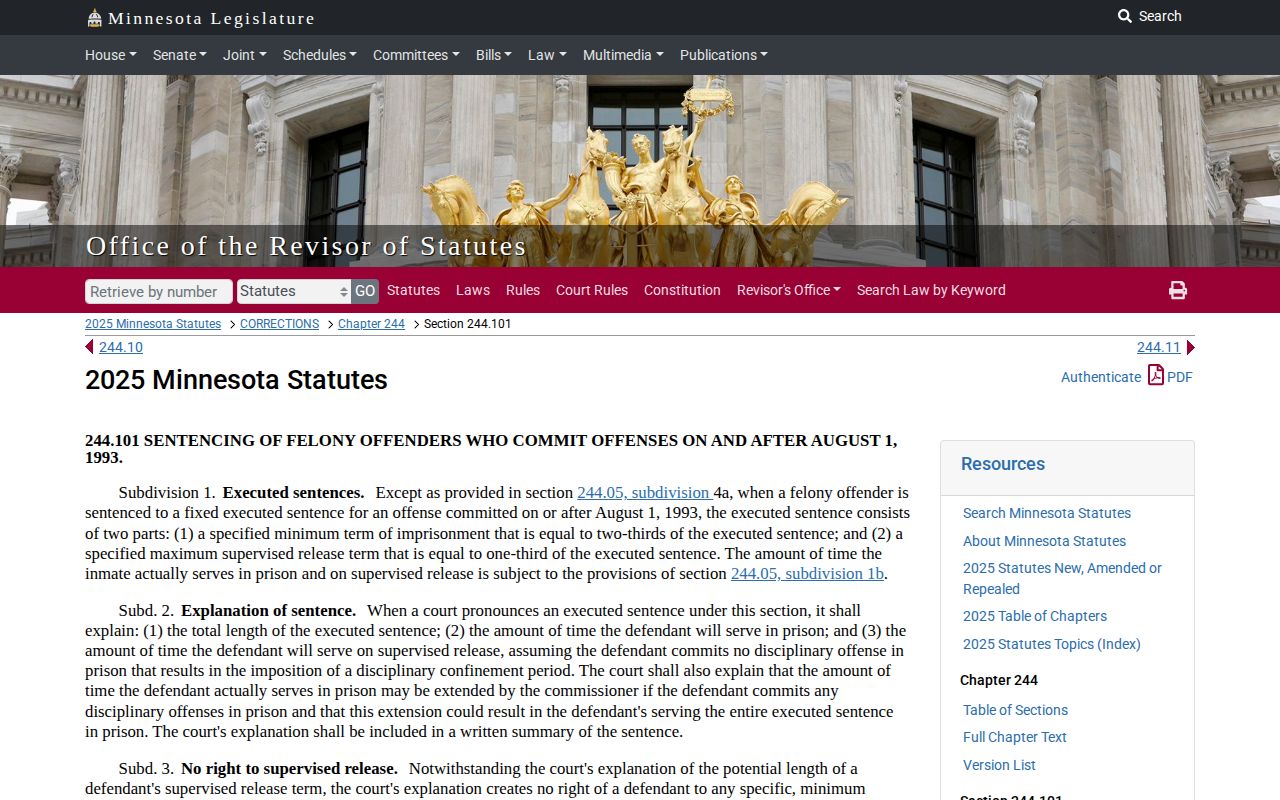
The statute supplies the base rule, but the official sentence and DOC calculation control each Itasca County case.
Ordinary covered cases do not wait for a parole board to choose release at two-thirds. Life sentences, older indeterminate sentences, qualifying cases involving a person under 18 at the offense, conditional-release terms, medical release, and other special laws can follow different paths.
Jail credit must also be read from the case-specific calculation. Time credited by the sentencing court can change how much of the prison term remains, while consecutive sentences can delay a community transition. Announced sentence length alone cannot supply a sound release date. The executed sentence, offense date, commitment record, credit, and current DOC calculation must be read together.
Itasca County Earned Release Credits
The word “good time” can mislead because Minnesota has different rules for different offense dates and programs. Section 244.04 generally provided one day of good time for each two days served without a disciplinary offense under the older framework. It does not apply to crimes committed on or after August 1, 1993, and it does not apply to mandatory life sentences. An old rule should never be used to estimate a modern Itasca County sentence.
The Minnesota Rehabilitation and Reinvestment Act adds earned incentive release credit for eligible modern cases. Section 244.41 links credit to objectives in an individualized rehabilitation plan. Section 244.44 says qualifying credit can reduce the imprisonment term by no more than 17 percent of the total executed sentence and cannot reduce imprisonment below one-half of that sentence. It does not enlarge the supervised-release portion.
The earned incentive release definitions are shown in the official statute capture.
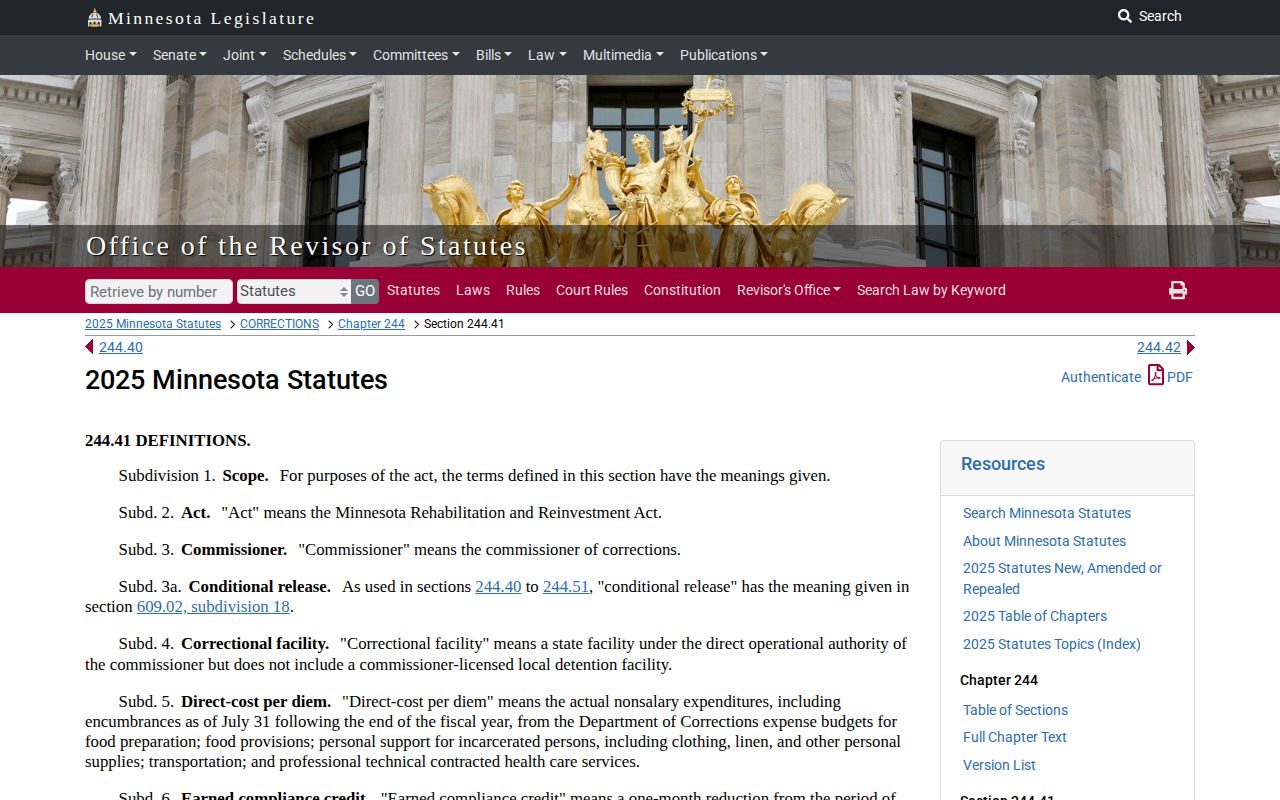
This source supports the credit category, while the DOC record remains necessary to learn whether a specific person is eligible and how credit was applied.
Eligibility is not universal. Section 244.45 excludes life sentences, specified older indeterminate cases, and people subject to the old good-time law or a comparable rule, among others. Credit may also be revoked for institutional rule violations or a criminal act while incarcerated.
Why Itasca County Release Dates Move
A displayed date can move in either direction as the record changes. The reason should come from the court, jail, or DOC calculation rather than guesswork. A later date does not always mean a new sentence, and an earlier date does not always mean final freedom.
| Factor | Possible effect on the date |
|---|---|
| Jail credit | Credited time already served can alter the remaining confinement calculation. |
| Discipline | Disciplinary confinement can extend prison time and reduce time left for supervision. |
| Earned incentive credit | Approved credit may reduce imprisonment for an eligible case within statutory limits. |
| Court amendment or appeal | A changed sentence or order can require a new calculation. |
| Concurrent or consecutive terms | The relationship among sentences affects when one term ends and the next begins. |
| Detainer or hold | Another agency may take custody even when the current facility’s term ends. |
| Special release program | CIP, medical release, or another authorized program can change the physical custody transition. |
Parole and supervised release must also be separated. Minnesota’s ordinary determinate cases usually enter statutory supervised release. The limited Supervised Release Board handles life sentences with release possibility, certain older indeterminate sentences, and other cases assigned by law. A board action can affect a covered person, but it is not the routine source for every state prisoner’s date.
Itasca County Weekend Release Rules
Minnesota Statutes section 244.05 contains release-day rules. For covered modern offenses, if the scheduled date falls on Friday, Saturday, Sunday, or a holiday, the supervised-release term begins on the first following day that is not one of those days. Older offenses have a different rule. The offense date and current statutory text must be checked before explaining any shift.
This rule concerns Minnesota prison supervised release. It should not be copied onto an Itasca County Jail case. A county jail date depends on the court commitment, the jail calculation, applicable local custody rules, and other holds. When the exact local date is disputed, request the jail’s release calculation and later release event.
Note: Weekend treatment can depend on the offense date, sentence type, and custodian, so the governing record must be identified first.
Togo Release Dates Mean Supervision
MCF–Togo creates an Itasca-specific date problem. The Minnesota DOC Challenge Incarceration Program has an institutional Phase 1 and later community phases. A qualifying participant can complete the intensive institutional phase and leave the physical Togo facility while remaining in an active state sentence under structured supervision.
The official MCF–Togo program description says Phase 1 is a six-month institutional program, while Phases 2 and 3 are generally six months each in the community. That transition may be the locally relevant “release date,” but it is not sentence expiration. DOC status, program phase, supervising office, and final discharge must be checked separately.
Departure from Togo can also mean a transfer, removal from the program, or another correctional move. “No longer at Togo” is not enough. Search the DOC public viewer, then seek DOC records when the visible fields do not identify the transition.
Confirm an Itasca County Release Date
For the county jail, call 218-326-3477 for current status and direct a copy request to the Itasca Records Division. Ask for the existing booking and custody record fields that show admission, release date and time, release disposition, release authority, and receiving agency where recorded and public. The court register explains the legal order, but the jail event records physical completion.
For a state prisoner, use DOC records and the public viewer. Specify the full name, MNDOC Offender ID if known, date of birth, facility, admission, transfers, release from confinement, supervision start, expiration or final discharge, and release type. Minnesota Haven can provide eligible event notice, but it is not a general historical locator.
DOC Records Information can be reached at co-records.doc@state.mn.us. The agency’s central office is at 1450 Energy Park Drive, Suite 200, St. Paul, Minnesota 55108, and the main telephone is 651-361-7200. A focused request is especially useful after final discharge, when the jurisdiction-limited public viewer may no longer return the person.
A pending county jail event may also be monitored through the Itasca County VINE inmate check. Treat the alert as corroboration and confirm the event with the custodian, especially when a transfer or hold may apply.