
MCF–Togo Release Paths
Minnesota Correctional Facility–Togo is a Level 2 minimum-security institution operated by the Minnesota Department of Corrections. Its central mission is the Challenge Incarceration Program, known as CIP. For a qualifying participant, departure from the Togo grounds can mark a move from the intensive institutional phase into supervised community phases. That physical departure is not final discharge. The person remains in an active sentence and must comply with DOC supervision.
A person may also leave because DOC transferred the person to another state facility, removed the person from the program, arranged medical movement, or made another custodial change. “No longer at Togo” is therefore too broad to prove community release. Confirm the destination, current status, program phase, supervising office, and sentence expiration separately. The Itasca County sheriff roster does not contain the state-prison record and cannot resolve these questions.
| Togo departure | Meaning | Best confirmation |
|---|---|---|
| Move to community CIP phase | Physical release with active DOC supervision | MN DOC viewer, agent, and DOC record |
| Transfer to another DOC facility | Continued state confinement elsewhere | MN DOC viewer and receiving facility |
| Program removal or medical move | Status depends on DOC action | DOC record and current placement |
| Final sentence expiration | DOC sentence and supervision end | Official discharge record |
Confirm an MCF–Togo Release
The MN DOC public viewer is the first public search for someone held or supervised by Minnesota corrections. It covers state custody and supervision records, not county-only cases. The search supports a person’s name or Minnesota DOC identification number. Newly sentenced people can take time to appear, and a common name requires careful comparison of available identifiers.
- Search the person in the MN DOC public viewer. Use the DOC number when known because it is more precise than a name.
- Open the correct record and read the current custody or supervision wording. Do not rely on the facility name alone.
- Check the release-related or projected date shown in the official record, if supplied. Treat a future date as changeable.
- Look for the supervising agent or office when the person has moved into a community CIP phase or supervised release.
- Contact MN DOC or MCF–Togo when the public fields do not distinguish a transfer, program change, or community movement.
- Request the person-specific state custody and release record when an official history or final discharge confirmation is needed.
The statewide viewer can show that custody or supervision changed, while a DOC record can document the underlying action. For someone returning to Itasca County, the MN DOC Grand Rapids office and ISR North Team supervise state-facility returnees according to the agency’s county fact sheet. The Itasca County release search overview compares this state path with county, court, federal, and immigration sources.
County-jail VINE does not cover MCF–Togo. Use MN DOC, Minnesota Haven when eligible, and the supervising office for state-prison events.
Note: A county VINE result cannot verify an MCF–Togo movement because Minnesota prison notifications use a separate state channel.
MCF–Togo Records and Contact
Contact the facility for current institution information and MN DOC for statewide records, status, and supervision questions. A county data request cannot produce a state correctional record held only by DOC.
Minnesota Correctional Facility–Togo
62741 County Road 551
Togo, MN 55723
Phone: 218-376-7878
Email: MCF-Togo.doc@state.mn.us
Minnesota Department of Corrections
1450 Energy Park Drive
St. Paul, MN 55108
Phone: 651-361-7200
Grand Rapids and Itasca Supervision
Phone: 218-322-2920
Felony probation and state supervised-release cases
Identify the person with a full name and DOC number, if known. State the exact fields needed, such as dates at Togo, movement destination, program phase, release to supervision, supervising office, sentence expiration, or final discharge. Some corrections, security, victim, medical, or protected personal information may not be public. Ask DOC to identify the governing classification when it withholds a requested field.
MCF–Togo Correctional Mission
The official MCF–Togo facility page describes a minimum-security site for adult male CIP participants. The stated limit is up to 90 people. That figure describes program capacity, not a live daily population. MN DOC publishes daily facility profiles and statewide statistics for dated population questions.
CIP makes Togo different from a conventional prison-release path. Phase 1 is an intensive institutional program for qualifying nonviolent participants and lasts six months according to the facility description. Phases 2 and 3 are generally six months each in the community under supervision. Progression can therefore cross the custody boundary before the sentence reaches final expiration.
Eligibility and completion must be confirmed for the individual. A program description cannot establish that a named person completed Phase 1, entered a community phase, remained compliant, or reached discharge. The official record and supervising agent supply those facts.
MCF–Togo Release History
Togo’s institutional history gives useful context for its unusual release path. The site opened in 1955 as Thistledew Camp for youth. In 2015, it changed to an adult minimum-security mission. Those milestones explain why older sources may describe a youth camp while current MN DOC material describes adult CIP participants.
The present three-phase design links a period at Togo with two supervised community phases. Finishing the first phase can therefore cause a person to leave the physical facility even though the DOC sentence remains active. In common speech, family or friends may call that a release. In the official record, the more exact description may be entry into a community phase or supervised release. Final discharge occurs only when the legal sentence and any DOC supervision end.
- Institutional phase
- The part of CIP served at the correctional facility.
- Community phase
- A structured CIP stage served outside Togo under supervision.
- Supervised release
- The community portion of a Minnesota sentence, subject to conditions.
- Final discharge
- The official end of the sentence and correctional supervision.
Note: A historical mission date or phase schedule cannot substitute for the current MN DOC record of an individual participant.
MCF–Togo Earned Release Credit
For ordinary covered Minnesota determinate felony sentences, the statutory starting point is a two-thirds imprisonment term and a one-third supervised-release term. Minnesota is not an 85-percent system. Jail credit, disciplinary time, consecutive or concurrent sentences, holds, amendments, special statutes, and release programs can change the operational date. Older offenses can fall under a different good-time law, so the offense date matters.
The Minnesota Rehabilitation and Reinvestment Act adds earned incentive release credit for eligible modern cases. Minnesota Statutes section 244.44 addresses calculation, limits, and revocation. The official statute screen below is the matching source captured for this MCF–Togo release topic.
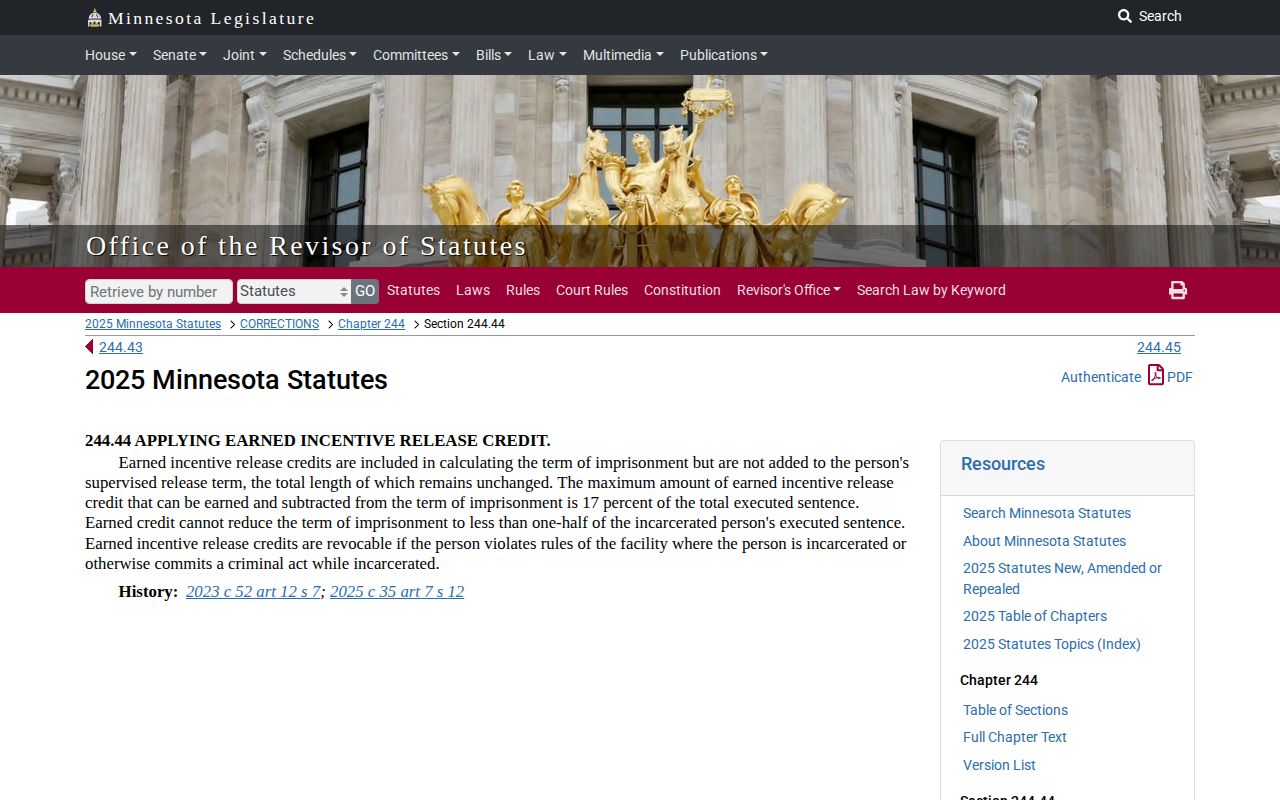
The statute permits eligible credit within stated limits and allows revocation for institutional-rule violations or a criminal act while incarcerated. It does not apply to everyone, and the related exclusions must be checked. The screenshot supports the governing rule, while the public viewer and DOC record show how the state applied current law to a particular sentence.
CIP progression is another program-specific factor, but it should not be merged with earned credit as though the two terms mean the same thing. A projected date remains an operational estimate. A move into supervised community phases is not final expiration, and a calculated credit does not guarantee the date will stay unchanged.
Note: Earned credit, CIP progression, supervised release, and final discharge are separate concepts that may produce different dates.
MCF–Togo Release Notifications
Minnesota Haven is the state correctional notification route for eligible people and events. Notifications may concern release, early-release programs, transfers, custody reductions, escape or apprehension, supervision changes, or assigned staff changes. The offered event depends on eligibility and the state record. Haven should be paired with the MN DOC public viewer and direct confirmation when the exact destination or legal status matters.
Minnesota VINE serves participating county jails. It does not cover a person simply because the state prison sits inside Itasca County. Registering through the Itasca sheriff roster follows an Itasca County Jail record, not an MCF–Togo participant. Keeping the channels separate prevents a false conclusion when one system has no result.
The supervision office can resolve another common ambiguity. Physical departure from Togo may be followed by community supervision through the Grand Rapids area office, ISR North, or another office tied to the approved release plan. Ask which office currently holds responsibility and whether the person is still in a CIP phase, on supervised release, or finally discharged.
Read MCF–Togo Release Records
Three dates can describe different events: departure from Togo, release from imprisonment to supervision, and final sentence expiration. A transfer adds another date without creating a community release. Record each label exactly as the source presents it. If a future date is shown, recheck near the event because sentence recalculation, discipline, a hold, a court amendment, or a program change can alter it.
Ordinary determinate supervised release generally follows statute rather than a routine discretionary parole hearing. The Minnesota Supervised Release Board handles a limited set of life, older indeterminate, and other assigned cases. Do not search for a general parole calendar to verify an ordinary Togo participant’s release. Use the sentencing record, MN DOC data, and person-specific supervision details.
The final result should distinguish place, custody, and sentence. “Not at Togo” concerns location. “In a community CIP phase” concerns program placement. “On supervised release” concerns the sentence’s community portion. “Discharged” means correctional supervision ended. Those distinctions turn a simple facility departure into an accurate Minnesota release record.