
Understanding Itasca County Released Inmates
“Released” is an event, not one fixed legal outcome. The Itasca County Jail can release a person to the community, but it can also transfer that person to another jail, the Minnesota Department of Corrections, the United States Marshals Service, or immigration custody. A court may order bond or conditional release. A local sentence may end. The person may instead leave Grand Rapids because another agency has authority to hold them. Each event removes the current roster card, yet only some mean the person is free in the community.
The custodian that moved the person keeps the strongest event record. For Itasca County released inmates, that is usually the jail’s booking and custody record, supported by Minnesota VINE and the court file. A person leaving Minnesota Correctional Facility–Togo follows a state route through the MN DOC public viewer, DOC records, and Minnesota Haven. Federal and immigration movements have separate locators. Start with the facility and read the recorded disposition literally.
- Release
- A physical departure from one custodian, sometimes to the community and sometimes to another authority.
- Transfer
- A move between custodians. It is not freedom.
- Supervised release
- The community portion of a Minnesota prison sentence under DOC authority.
- Final discharge
- The end of the correctional agency’s legal authority for that sentence.
Itasca County Release Types
A release label answers only part of the question. Bond and conditional release often place a person outside the jail while the criminal case remains open. Time served means the credited custody portion is complete at that point, though probation or another case may continue. A dismissal describes the case result, but the jail record is still needed for the actual time of departure. DOC commitment, USMS transfer, or an ICE handoff means custody changed hands.
| Recorded event | What it means | Next source |
|---|---|---|
| Bond or conditions | Physical community release while the case proceeds | Jail release record and court register |
| Time served | Credited jail term is complete | Release entry, sentencing order, probation office if ordered |
| DOC commitment | County custody ends and state custody begins | MN DOC public viewer after processing |
| Agency transfer | Another jail or authority takes custody | Receiving agency record or locator |
| Sentence complete | The stated sentence may have ended | Check other holds and final-discharge records |
A disappearance from the Itasca County roster does not supply one of these labels. The record’s release disposition and receiving-agency field, if public and recorded, make the critical distinction. A VINE event can quickly corroborate a custody change, but the alert text must still be checked for release, transfer, escape, death, or another event.
Note: A transfer closes one Itasca custody episode but begins another agency’s record trail and does not prove community release.
Itasca County Release Record Fields
The sheriff’s public roster is not a release archive. It shows a current person’s name, photograph, charge link, and a “Notify Me of Status Change” link. It does not promise a booking date, release timestamp, release reason, projected date, or archive switch. The underlying Itasca County Jail booking and custody record is the better source after a card drops away.
| Requested field | What it can establish |
|---|---|
| Name and local identifier | Connects the event to the correct booking |
| Admission date and time | Marks the start of the jail custody episode |
| Release date and time | Records when Itasca custody ended |
| Release disposition or reason | Distinguishes bond, time served, court order, transfer, or commitment |
| Ordering authority | Identifies the court or agency behind the event |
| Receiving agency | Shows the destination of a transfer when recorded and public |
| Booking photograph | Links the official image to the booking episode |
Not every field must exist or be public. Minnesota law classifies data field by field. Juvenile, sealed, expunged, active-investigation, victim, medical, security, or other protected details may be redacted. A release reason also may not state a destination. Ask for existing fields without demanding a conclusion or a newly built report.
Request Itasca County Release Records
The current route is the Itasca County data-request portal or the Records Division at the sheriff’s current address. The older public-information form remains useful for understanding the requested details and delivery choices, but its return address conflicts with the current Records Division page. Use the portal or call before mailing anything.
- Identify the person by full name, date of birth if known, and approximate booking date.
- Ask for the existing booking and custody record, including the release date, release disposition, legal authority, and public receiving-agency field.
- Request the booking photograph if needed and prefer an electronic copy. Ask to inspect first if that avoids copy charges.
- Ask the county to cite the legal classification for any withheld field. Do not demand a custom release list the county does not keep.
- Compare the result with VINE and the court register when the timing, destination, or legal basis needs context.
108 NE 5th Street
Grand Rapids, MN 55744
218-327-7472
Monday through Friday, 8:00 a.m. to 4:30 p.m.
Public inspection is free. The county manual lists black-and-white letter or legal copies of no more than 100 pages at 25 cents per one-sided page or 50 cents per two-sided sheet. Other copies can reflect actual cost, and the manual lists employee time at $20.53 per hour. Confirm current rates. Minnesota law requires a reasonably prompt response, but no universal fixed turnaround applies to every request.
Law on Itasca County Release Records
Minnesota Statutes section 13.03 presumes government data public unless another law classifies it differently. It provides free inspection and permits authorized copy charges. Section 13.82 classifies core law-enforcement data and makes a booking photograph public unless temporary release would harm an active investigation. That law does not require the sheriff to create a list that is not kept or leave a released person’s card online forever.
Sections 13.84 and 13.85 protect some court-services, corrections, and detention data. Expungement seals public access but does not destroy every government copy. A blank MCRO search or vanished roster card therefore has several possible causes. The right response is a field-specific request to the custodian, not an assumption that the entire Itasca County release record was deleted.
Note: Ask the custodian to cite the classification for each withheld field instead of treating one redaction as a closed record.
Do Itasca Jail Fees Follow Release?
An official county policy from 2003 authorized a $20 daily jail stay fee and recognized waiver considerations. The Itasca County probation FAQ also says court-ordered community work service can address pay-for-stay accounts in some cases. This is distinctive local history, but it is not proof that every released person owes the charge now.
Ask the sheriff, court, or supervising office whether the old policy applies to the specific custody episode. Keep the fee issue separate from the fact of release. An unpaid account does not change a release timestamp, and a historical policy should not be described as a current automatic debt without confirmation.
Find Released Itasca County Inmates
There is no universal released-person search. Choose the path by custodian. The sheriff’s roster answers whether someone is currently displayed at the Itasca County Jail. VINE follows county-jail custody events. MN DOC covers state commitments and people still under state authority. MCRO explains the court case. BOP, USMS, and ICE handle different federal systems.
- Search the official Itasca County current roster. A present card means the person is still displayed in county custody, not confirmed released.
- If the card is absent, search Minnesota VINE and call the jail. Record the exact alert or status wording and its timestamp.
- Read the Itasca District Court register for bond, dismissal, sentencing, commitment, warrant, or revocation context.
- If a DOC commitment or Togo placement is possible, use the MN DOC viewer. Allow for entry and transfer lag.
- If federal or immigration custody is possible, use the correct BOP, federal docket, USMS, or ICE route.
- Request the existing release event from the Records Division when public pages cannot prove the date, reason, or destination.
When sources conflict, do not average them into one answer. If VINE says released while the roster still shows the card, call the jail. If the court ordered release but the roster remains, processing or another hold may explain the delay. Save each system’s wording and time.
Note: A timestamped jail response carries more weight for physical release than an untimed absence from a public roster.
MN DOC Search for Itasca Releases
The MN DOC public viewer is for adults committed to the corrections commissioner who remain under DOC jurisdiction, including people outside prison on supervised release. It is not an Itasca County booking archive. A person fully discharged from DOC authority may no longer appear, and a person released only from the county jail may never belong in this system.
| Search field | Use | Important limit |
|---|---|---|
| First and last name | Uses prefix behavior and includes some prior names or aliases | Verify identity before relying on a match |
| MNDOC Offender ID | Enter the complete six-digit identifier | County booking numbers are different |
| Birth Date | Helps distinguish similar names in results | Read exactly as displayed |
| Current Status | Shows the current DOC jurisdiction label | Do not rename the official status |
The official MN DOC interface shows the search route used for state custody and supervision records.
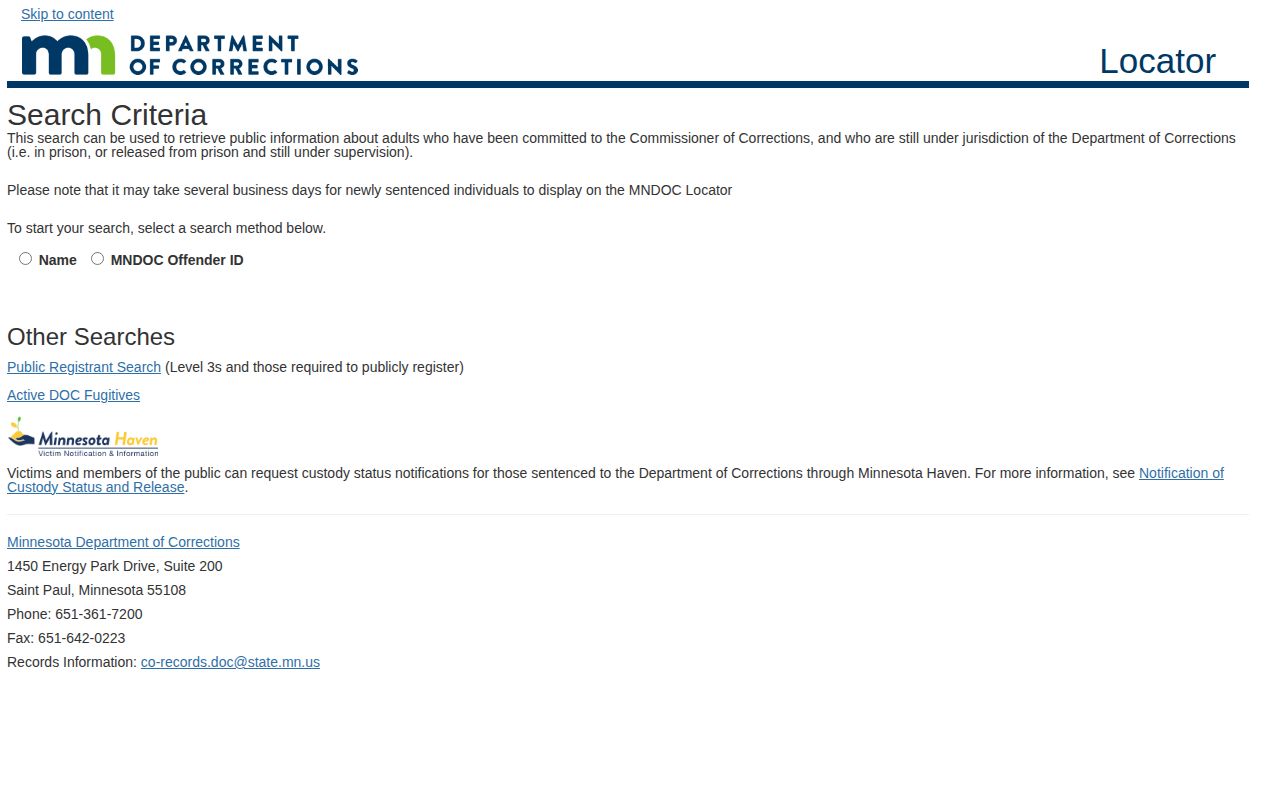
The viewer’s labels must be read as written because a release date, supervision date, projected date, and expiration date can describe different points in one sentence.
Itasca County Recent Release Search
Itasca County publishes no verified rolling 24-hour or 72-hour release feed. The sheriff’s visible routes include current inmate search and Recent Arrests. The latter is an intake page, not evidence that custody ended. The sitemap exposes no recent-release route. A person seeking a date-window list must ask for existing release events between exact start and end times, not require the county to create a new arrangement.
The official sheriff roster shows how current cards combine the name, booking photograph, charge details, and direct VINE registration.
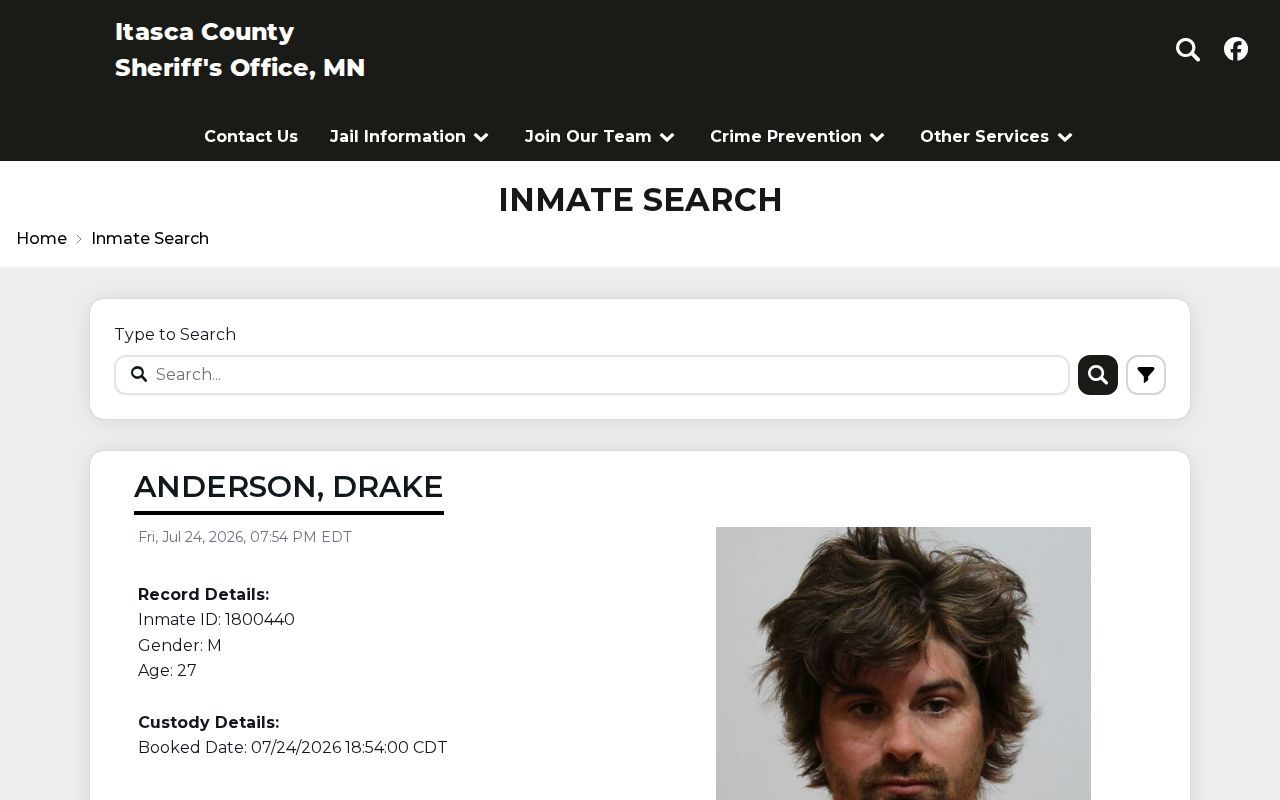
Once that card disappears, use VINE, the jail, court context, and a records request. The sheriff does not publish a roster cadence or a post-release retention promise.
Itasca Court Records and Releases
Itasca County District Court belongs to Minnesota’s Ninth Judicial District. Its public calendar posts on business days and updates hourly, but scheduling is not proof of release. Some matters are omitted. A hearing entry says where a case is set, not when jail staff completed a custody event.
Use Minnesota Court Records Online for the register of actions, accessible filed documents, and disposition context. Bond terms, dismissal, sentencing, amended sentences, warrants, revocations, and discharge entries can explain why custody changed. For the exact physical release time, return to the jail record. Public courthouse terminals may show a fuller electronic file than remote MCRO.
Note: The court calendar is a scheduling aid, while the register and jail record document legal action and physical custody separately.
Itasca County Supervision After Release
Itasca County Probation supervises adults on misdemeanor and gross-misdemeanor probation, while MN DOC handles felony probation and supervised release from state facilities. The county says an adult probation officer’s identity can be requested by phone or in person. Juvenile officer information is not public. For a felony case or a person returning from prison, the MN DOC Grand Rapids and Itasca supervision office is the correct local contact.
Probation does not prove the minute a person left jail. Supervised release also does not mean the sentence ended. A person can live in the community while remaining under DOC authority. Confirm the custody event with the releasing agency, then confirm the current supervision status with the responsible county or state office.
Itasca Release Alerts and Federal Records
Minnesota VINE is the county-jail notification channel. Search by name or offender ID, select the correct Itasca record, and register for the phone, email, text, or app options offered. Keep the PIN. County-jail updates are typically refreshed every 15 or 30 minutes, but that is VINE’s cadence, not a promised sheriff-webpage cadence. Minnesota prison notifications use Minnesota Haven instead.
For a federal sentenced person, the BOP inmate locator covers records from 1982 forward. “Released” or “Not in BOP custody” does not rule out another custodian or supervision. A federal pretrial move requires the federal docket and USMS records. ICE’s locator focuses on current detention, so no result can reflect spelling, processing, transfer, short custody, removal, or release. Match the system to the custody type.
Could an Itasca Release Mean ICE?
The Itasca County Sheriff’s Office entered an ICE 287(g) Task Force Model agreement dated February 25, 2025. That local relationship makes an immigration transfer a real issue to check. It does not turn the county jail into a verified ICE detention center, prove that a named person was transferred, or show that every vanished roster card involves immigration authorities.
Ask for the jail’s public release disposition and receiving agency. Then check the ICE locator and immigration-record route when the record supports an ICE handoff. If the person instead moved under USMS, BOP, MN DOC, or another county, use that agency’s record. The chain must be person-specific.
Where Itasca County Release Records Appear
Each public system has a narrow role. A current-custody roster cannot replace a release record, and a court order cannot always supply the physical departure time.
| Question | Best source | What it does not prove |
|---|---|---|
| Still displayed in county jail? | Itasca sheriff roster and jail | Past release history |
| When did county custody end? | Jail custody and release record | That transfer meant community freedom |
| Under Minnesota prison authority? | MN DOC public viewer and records | A county-only booking event |
| What did the court order? | MCRO and Itasca District Court | The exact jail processing minute |
| No longer held by BOP? | BOP locator and FOIA | No other custody or supervision |
| Currently held by ICE? | ICE locator and record request | That no result means community release |
Note: Record the exact system label because “released,” “supervised,” “transferred,” and “not in custody” answer different questions.
MCF–Togo Release Phase Changes
Itasca County contains a distinctive state facility. MCF–Togo’s Challenge Incarceration Program uses an institutional phase followed by supervised community phases for qualifying participants. The first phase is described as six months at the facility, while the next two phases are generally six months each in the community. Leaving Togo can therefore be physical release into Phase 2 without being sentence expiration or final discharge.
The MN DOC record, program phase, and supervising office must distinguish community placement from a transfer, program removal, or full discharge. A date for departure from Phase 1 answers a different question than the sentence-expiration date.
Itasca’s Togo Correctional History
MCF–Togo began as the Thistledew youth camp in 1955. Minnesota changed the site to an adult minimum-security mission in 2015. That shift explains why an older local source may describe a youth camp while current MN DOC records identify adult Challenge Incarceration Program participants.
The history also gives the Itasca County release path unusual local meaning. Togo is not a branch of the county jail, and its departures never belong in the sheriff roster. A present-day movement must be verified through the state facility record, DOC viewer, Minnesota Haven when eligible, and the assigned supervision office.
Itasca County Release Facilities
Two adult detention or correctional institutions were verified in Itasca County. The Itasca County Jail is the sheriff-run county facility for pretrial, local-sentence, hold, and transfer cases. Its release proof comes from the sheriff’s custody record, VINE, and court context. Minnesota Correctional Facility–Togo is a Level 2 state prison for Challenge Incarceration Program participants. Its departures belong in MN DOC, Minnesota Haven when eligible, and state supervision records.
No separate municipal lockup, BOP prison, ICE detention center, or USMS detention facility inside Itasca County was verified. A federal or immigration detainee can still pass through a local facility, so always check the named person’s receiving agency.